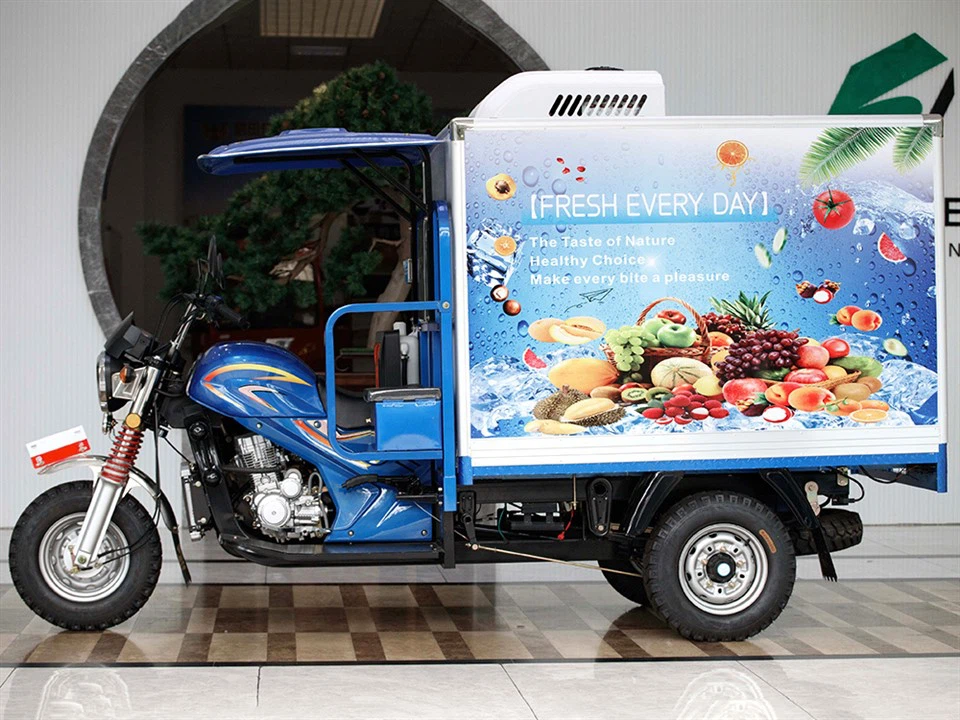
When it comes to water tank tricycles, understanding their typical dimensions is crucial for various reasons, whether you're in the market to purchase one or simply interested in the technical aspects of these versatile vehicles. As a supplier of water tank tricycles, I've had the privilege of working closely with these machines and can provide valuable insights into their dimensions.
Overall Length
The overall length of a typical water tank tricycle can vary depending on the size of the water tank and the design of the tricycle. Generally, the length ranges from about 2.5 meters to 3.5 meters. A shorter length is often preferred for urban environments where maneuverability is key. These shorter tricycles can easily navigate through narrow streets and congested areas, making them ideal for delivering water to residential areas or small businesses. On the other hand, longer tricycles may be equipped with larger water tanks, allowing for more water to be transported in a single trip. This is beneficial for industrial applications or large - scale water delivery projects.
Overall Width
The width of a water tank tricycle usually falls between 1.2 meters and 1.5 meters. This width is designed to strike a balance between stability and the ability to pass through standard doorways and narrow passages. A wider tricycle provides more stability, especially when carrying a full load of water. However, it may face limitations in terms of where it can operate. A narrower tricycle, while more maneuverable, may require more careful handling to maintain stability, especially on uneven terrain.
Overall Height
The height of a water tank tricycle is typically around 1.8 meters to 2.2 meters. This height is important for several reasons. Firstly, it affects the center of gravity of the vehicle. A lower height generally means a lower center of gravity, which enhances stability. Secondly, it determines whether the tricycle can pass under low - lying structures such as bridges or overhangs. For example, in areas with low - clearance bridges, a tricycle with a lower height would be more suitable.
Water Tank Dimensions
The water tank is the most important component of a water tank tricycle, and its dimensions play a significant role in the vehicle's overall performance. The capacity of the water tank can range from 500 liters to 2000 liters. Smaller tanks are more suitable for short - distance deliveries or areas with limited water demand, such as small shops or individual households. Larger tanks, on the other hand, are used for long - distance deliveries or large - scale projects, such as construction sites or agricultural irrigation.
The shape of the water tank also varies. Common shapes include cylindrical and rectangular. Cylindrical tanks are often preferred because they provide better structural integrity and are more efficient in terms of space utilization. Rectangular tanks, however, can be more easily customized to fit the available space on the tricycle.
Wheelbase
The wheelbase of a water tank tricycle, which is the distance between the front and rear axles, is typically between 1.5 meters and 2 meters. A longer wheelbase provides more stability, especially when the tricycle is carrying a heavy load. It also allows for a smoother ride, as the vehicle is less likely to be affected by small bumps and irregularities on the road. A shorter wheelbase, on the other hand, makes the tricycle more maneuverable, which is an advantage in tight spaces.
Ground Clearance
Ground clearance is another important dimension. It refers to the distance between the lowest point of the tricycle (usually the bottom of the water tank or the frame) and the ground. A typical water tank tricycle has a ground clearance of about 150 mm to 200 mm. Adequate ground clearance is essential for the tricycle to operate on rough or uneven terrain without getting stuck or damaging the undercarriage. It also allows the tricycle to cross small obstacles such as speed bumps or curbs.
Applications and Dimensions
The dimensions of a water tank tricycle are closely related to its applications. For example, if the tricycle is intended for use in a crowded urban area, a smaller and more maneuverable design with a shorter length, width, and wheelbase would be more appropriate. On the other hand, for industrial or agricultural use, a larger tricycle with a bigger water tank and higher ground clearance may be required.
In urban water delivery, tricycles need to be able to access narrow alleys and residential areas. This is where the dimensions of the tricycle become crucial. A tricycle that is too large may not be able to reach the end - users, while a well - dimensioned tricycle can efficiently navigate through these areas and deliver water directly to the customers.
In industrial settings, such as factories or construction sites, the focus is often on the water - carrying capacity. A tricycle with a large water tank can reduce the number of trips required to supply water, increasing efficiency and reducing operational costs.


Comparison with Other Tricycle Types
It's interesting to compare the dimensions of water tank tricycles with other types of tricycles. For instance, Electric Refrigerated Three - wheeled Truck is designed to transport refrigerated goods. These trucks often have a different set of dimensions to accommodate the refrigeration unit. They may be wider and taller to provide enough space for the cooling system and the storage area.
Fully Enclosed Tricycle is another type that has distinct dimensions. These tricycles are designed to protect the rider and the cargo from the elements. They usually have a more compact design, with a shorter length and height, to ensure easy navigation and protection from wind and rain.
Trike Food Cart also has unique dimensions. They are designed to have a large enough area to prepare and serve food, which often means a wider and longer body compared to a standard tricycle.
Conclusion
In conclusion, the dimensions of a typical water tank tricycle are carefully designed to meet the specific needs of water delivery. The length, width, height, water tank capacity, wheelbase, and ground clearance all play important roles in the vehicle's performance, maneuverability, and stability. Whether you're in the market for a water tank tricycle for urban delivery, industrial use, or agricultural applications, understanding these dimensions is essential to make an informed decision.
If you're interested in purchasing a water tank tricycle, or if you have any questions about the dimensions or other aspects of these vehicles, I encourage you to contact us for a detailed discussion. We're here to help you find the perfect water tank tricycle that meets your requirements.
References
- Industry standards for water tank tricycles
- Manufacturer's specifications and brochures
- Field studies on the performance of water tank tricycles in different applications