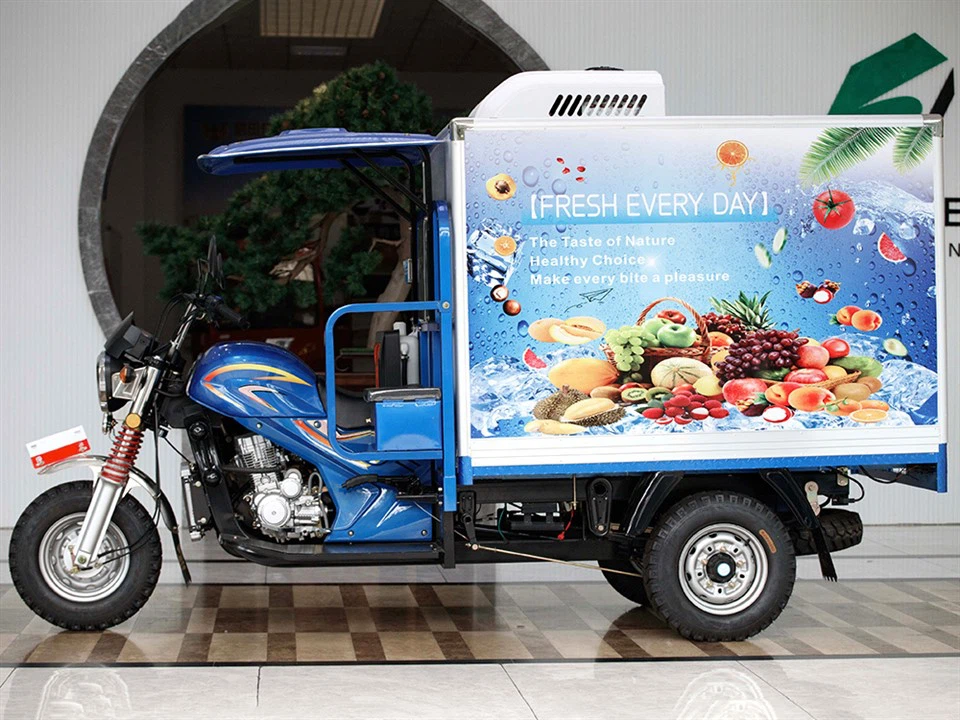
As a supplier of Farm Tricycles, I've witnessed firsthand the importance of proper lighting systems on these practical vehicles. Farm tricycles are versatile workhorses on the farm, used for various tasks from transporting goods to navigating through fields at different times of the day. In this blog, I'll delve into the different lighting systems commonly found on farm tricycles, their functions, and why they matter.
Headlights
The most prominent lighting components on a farm tricycle are the headlights. These are essential for providing forward illumination, allowing the operator to see clearly in low - light conditions, such as early morning or late evening work on the farm. Headlights come in different types, each with its own set of advantages.


Halogen Headlights
Halogen headlights have been a staple in the automotive and tricycle industry for a long time. They work by passing an electric current through a tungsten filament inside a glass bulb filled with halogen gas. The heat generated causes the filament to glow, producing light. Halogen headlights are relatively inexpensive to manufacture and replace, making them a cost - effective option for farm tricycles. They also provide a warm, yellow - tinted light that is familiar to most operators. However, they are not as energy - efficient as some other types of headlights and have a shorter lifespan compared to LED headlights.
LED Headlights
LED (Light - Emitting Diode) headlights are becoming increasingly popular on farm tricycles. LEDs are semiconductor devices that emit light when an electric current passes through them. They offer several advantages over halogen headlights. Firstly, they are highly energy - efficient, consuming less power while producing a brighter and more focused light. This means that they put less strain on the tricycle's electrical system and can help save on fuel consumption if the tricycle is powered by a gasoline engine. Secondly, LED headlights have a much longer lifespan, often lasting up to 50,000 hours or more. This reduces the frequency of headlight replacements, which is especially beneficial for farm tricycles that are used frequently. Additionally, LED headlights can be designed to produce a white or blue - tinted light that provides better visibility and contrast, making it easier to spot obstacles on the road or in the fields.
Taillights
Taillights are another crucial part of the lighting system on a farm tricycle. They serve two main functions: to make the tricycle visible from the rear and to indicate the tricycle's movements to other road users.
Brake Lights
Brake lights are a type of taillight that illuminate when the operator applies the brakes. They are designed to alert drivers behind the tricycle that the vehicle is slowing down or coming to a stop. Brake lights are typically brighter than the regular taillights and are often red in color to make them more visible. On farm tricycles, brake lights are essential for safety, especially when the tricycle is used on public roads or in areas with other vehicles.
Turn Signals
Turn signals are used to indicate the tricycle's intention to turn left or right. They flash on and off to grab the attention of other road users. Turn signals are usually located on the rear and sometimes on the front of the tricycle. They are an important safety feature that helps prevent accidents by allowing other drivers to anticipate the tricycle's movements.
Side Lights
Side lights, also known as marker lights, are small lights located on the sides of the farm tricycle. They are used to increase the tricycle's visibility from the side, especially in low - light conditions. Side lights are particularly useful when the tricycle is parked on the side of the road or when it is being used in areas with poor lighting. They can also help other road users judge the width of the tricycle, which is important for safe passing.
Work Lights
In addition to the standard headlights, taillights, and side lights, some farm tricycles are equipped with work lights. Work lights are designed to provide additional illumination for specific tasks, such as loading and unloading cargo, working in barns or sheds, or performing maintenance on the tricycle.
Flood Lights
Flood lights are a type of work light that produces a wide - spread beam of light. They are ideal for illuminating large areas, such as a loading dock or a field. Flood lights can be mounted on the front, rear, or sides of the tricycle, depending on the specific needs of the operator.
Spot Lights
Spot lights, on the other hand, produce a narrow and intense beam of light. They are useful for focusing light on a specific object or area, such as a piece of equipment or a small work area. Spot lights can be adjusted to point in different directions, allowing the operator to direct the light where it is needed most.
Importance of Proper Lighting Systems
Proper lighting systems on a farm tricycle are essential for several reasons. Firstly, they enhance safety. Good headlights and taillights make the tricycle visible to other road users, reducing the risk of accidents, especially when the tricycle is used on public roads. Work lights also improve safety by providing adequate illumination for tasks that are typically performed in low - light conditions. Secondly, proper lighting can improve productivity. With good lighting, operators can work more efficiently, especially during early morning or late evening hours. They can see their surroundings clearly, which allows them to handle cargo more accurately and navigate through the fields without getting stuck or causing damage to the tricycle or the crops.
If you are in the market for a reliable farm tricycle with high - quality lighting systems, look no further. Our Farm Tricycle models are designed to meet the diverse needs of farmers and agricultural workers. We also offer Gasoline Cargo Tricycle and Heavy Duty Tricycle options that come with advanced lighting features. Whether you need a tricycle for daily farm chores or heavy - duty transportation, we have the right solution for you.
If you are interested in our products, we encourage you to reach out to us for a detailed discussion about your requirements. Our team of experts is ready to assist you in finding the perfect farm tricycle that suits your needs and budget.
References
- Automotive Lighting Handbook, edited by Helmut Heislitz and Wolfgang R. Gessner
- Lighting Technology: Principles and Applications by John M. Bullough and Miloslav K. Rea