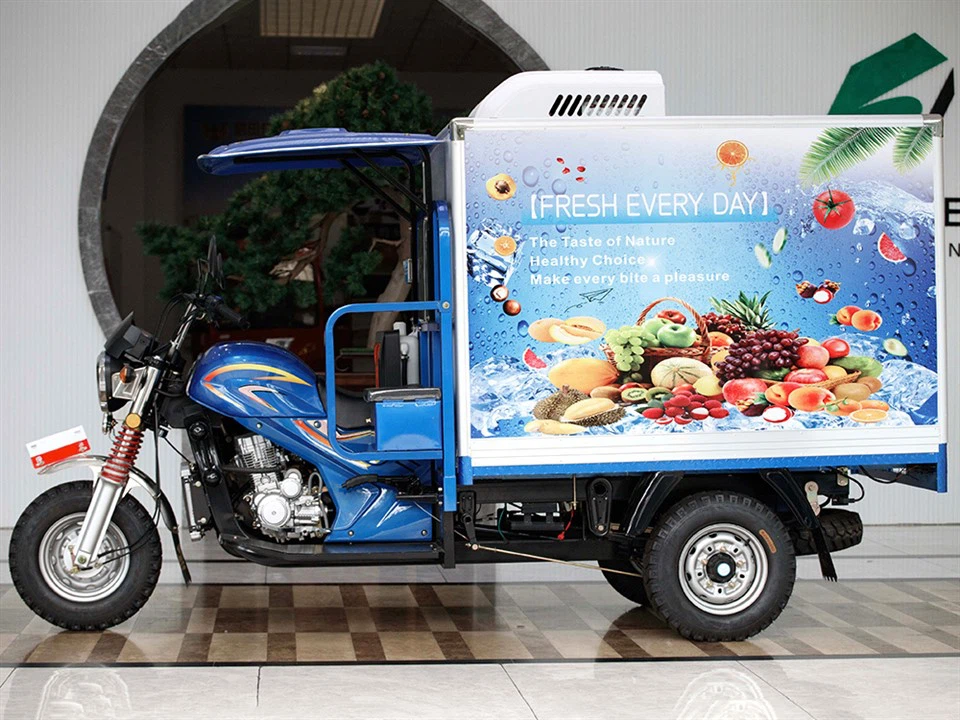
What is the average speed of a refrigerated tricycle during normal operation?
As a supplier of refrigerated tricycles, I often get asked about the average speed of these vehicles during normal operation. Understanding the speed capabilities of refrigerated tricycles is crucial for businesses that rely on them for transporting perishable goods. In this blog post, I'll delve into the factors that influence the average speed of a refrigerated tricycle and provide some insights based on industry standards and real - world experience.
Factors Affecting the Average Speed
- Motor Power
The motor is the heart of a refrigerated tricycle. Tricycles with more powerful motors can generally achieve higher speeds. Most of the refrigerated tricycles we supply come with motors ranging from 500W to 2000W. A 500W motor may have a top speed of around 20 - 25 km/h, while a 2000W motor can push the tricycle to speeds of up to 40 - 50 km/h. However, the average speed during normal operation is usually lower than the top speed. For instance, a tricycle with a 1000W motor might have a top speed of 35 km/h, but during normal, loaded operation, it will typically hover around 25 - 30 km/h. - Load Capacity
The weight of the refrigerated cargo significantly impacts the speed. A fully loaded refrigerated tricycle will move slower than an empty one. Our refrigerated tricycles are designed to carry different load capacities, depending on the model. Some can carry up to 300 kg of refrigerated goods. When fully loaded, the tricycle has to work harder to move, which reduces the speed. For example, if an unloaded tricycle can travel at 30 km/h, when loaded with 200 kg of perishable items, its speed might drop to 20 - 25 km/h. - Terrain
The type of terrain on which the tricycle operates plays a vital role. On flat, smooth roads, the tricycle can maintain a relatively high speed. However, on hilly or rough terrains, the speed will be severely affected. Uphill climbs require more power, and the tricycle's speed can drop to as low as 10 - 15 km/h, depending on the steepness of the slope. Even on slightly uneven roads, the speed might be reduced by 5 - 10 km/h compared to flat surfaces. - Battery Condition
The battery is another key factor. A fully charged battery provides more power to the motor, allowing the tricycle to maintain a good speed. As the battery discharges, the power output decreases, and so does the speed. For example, if a tricycle starts its journey with a fully charged battery and can travel at 25 km/h, towards the end of the battery's charge cycle, the speed might drop to 20 km/h or even lower.
Average Speed in Different Scenarios
- Urban Delivery
In urban areas, the average speed of a refrigerated tricycle is usually between 15 - 25 km/h. This is due to traffic congestion, frequent stops at intersections, and the need to navigate through narrow streets. The tricycle has to slow down to make deliveries at various locations, and the overall traffic conditions limit the speed. For instance, in a busy city center, the tricycle might only be able to move at 15 km/h on average, while in less congested urban areas, it could reach 25 km/h. - Suburban Delivery
Suburban areas generally have less traffic and wider roads. Here, the refrigerated tricycle can achieve an average speed of 25 - 30 km/h. There are fewer stops, and the terrain is often flatter. However, there may still be some speed - reducing factors such as occasional traffic lights and speed limits. - Rural Delivery
In rural areas, the average speed can be higher, around 30 - 35 km/h. The roads are less congested, and there is more open space. But rural roads can also be rough in some cases, which might reduce the speed slightly. If the roads are well - maintained, the tricycle can reach the upper end of this speed range.
Industry Standards
The industry does not have a strict, one - size - fits - all standard for the average speed of refrigerated tricycles. However, based on our experience and feedback from customers, a reasonable average speed for a typical, medium - sized, loaded refrigerated tricycle operating in a mix of urban and suburban areas is around 20 - 25 km/h. This speed allows for efficient delivery while also ensuring the safety of the driver and the integrity of the refrigerated goods.
Comparison with Other Similar Tricycles
When compared to other types of tricycles, such as the Community Patrol Motorcycle and the Postal Trike, the refrigerated tricycle's speed is generally lower. Community patrol motorcycles are designed for quick movement and can reach higher speeds, often up to 40 - 50 km/h. Postal trikes, on the other hand, are also relatively fast, with an average speed of around 30 - 35 km/h, as they usually carry lighter loads and are optimized for quick mail delivery. The refrigerated tricycle's slower speed is mainly due to the weight of the refrigeration unit and the perishable cargo it carries.
The Role of Speed in Business Operations
The speed of a refrigerated tricycle directly impacts the efficiency of the delivery business. A faster tricycle can make more deliveries in a given time, increasing the business's productivity. However, it's important to balance speed with safety and the integrity of the refrigerated goods. If the tricycle moves too fast, it might cause the goods to shift inside the refrigerated compartment, potentially damaging them. Also, high - speed operation can increase the risk of accidents, which can be costly for the business.
Conclusion
In conclusion, the average speed of a refrigerated tricycle during normal operation is influenced by multiple factors, including motor power, load capacity, terrain, and battery condition. In different scenarios, such as urban, suburban, and rural deliveries, the speed varies. On average, in a typical delivery environment, a refrigerated tricycle will travel at around 20 - 25 km/h.
If you are in the business of perishable goods delivery and are considering purchasing a refrigerated tricycle, it's essential to understand these speed - related factors. Our company offers a range of high - quality refrigerated tricycles, designed to meet different business needs. We can provide you with detailed information about the speed capabilities of each model based on your specific requirements. Whether you need a tricycle for urban deliveries or long - distance rural trips, we have the right solution for you. If you're interested in learning more about our products or starting a procurement negotiation, please feel free to reach out. We look forward to working with you to find the perfect refrigerated tricycle for your business.


References
- Industry reports on electric tricycle performance
- Internal testing data from our company's research and development department
- Customer feedback on the speed and performance of our refrigerated tricycles